The Taxonomy of U.S. Youth Sports Level 1: Organized or No?
This is the first in a series of posts that will look at the structure of youth sports in the United States.
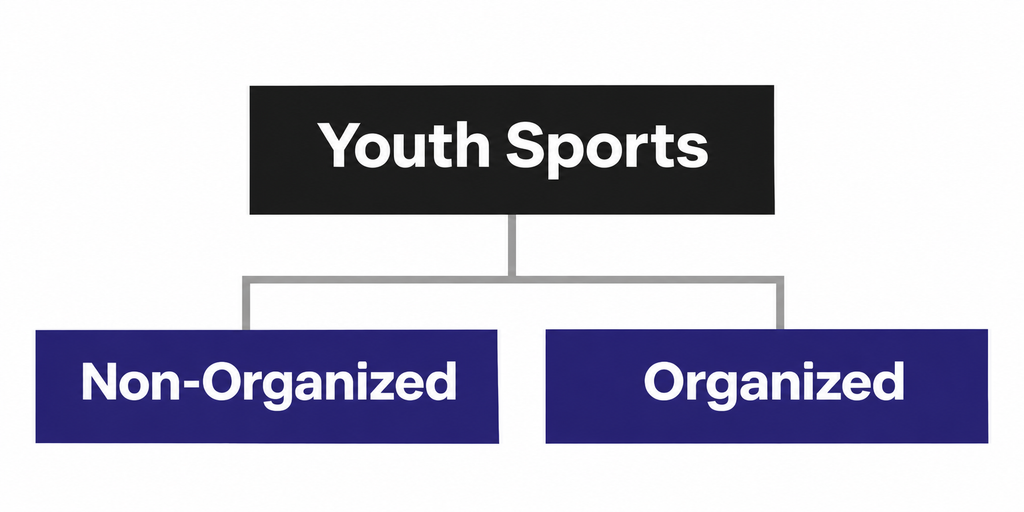
One conception of the “top” level of the taxonomy of youth sports is determining whether a sport is “organized” or “non-organized.”1
Organized Youth Sports
Organized sport can be described as looking something like the professional sport we see on TV. These include:2
- Registered and “eligible” players;
- That form teams;3
- A particular activity (soccer, basketball, etc.);
- A pre-determined (and often formally arranged) location;
- A “purpose” (a practice/training session, a league, a playoff, a scrimmage, etc.);
- A scheduled start time;
- Referees (for games);
- Uniforms (for games and sometimes for training);
- Fixed rules;
- Coaches; and
- The expected application of certain standards.
Organized youth sports are also often adult-managed and adult-driven.
Non-Organized Youth Sports
Non-organized youth sports often do not have as many differentiating factors from organized sport as one may initially think. Non-organized youth sports may have:
- A particular activity (soccer, basketball, etc.);
- A pre-determined location (often informally arranged);
- Sometimes flexible rules;
- A “purpose” (a practice/training session, a league, a playoff, a scrimmage, etc.); and
- A scheduled (or at least widely-understood) start time.
Non-organized youth sport usually does not have:
- Registered and “eligible” players;
- A “purpose”;
- Uniforms;
- Referees;
- Coaches; and
- The expected application of certain standards.
Non-organized youth sports are usually player-managed and player-driven.
The Taxonomy So Far
This information leads us to a taxonomy the top levels of which look like this:
So, What’s the Main Difference?
The primary difference between organized and non-organized youth sports is the expected application of certain standards.
This is not to say that non-organized youth sports are without standards. There are expectations for behavior (a reasonable degree of sportsmanship within the “looser” organizational context, a general commitment to follow the “rules” of the game as played when organized, etc.).
What is intended through the discussion of the application of “certain standards” in this context is the set of behaviors (sometimes referred to as life skills) that accompany the participation in organized youth sports (and that you sports are touted to teach and develop),4 which include:
- Commitment (reliability, punctuality, time management);
- Appropriate dress as prescribed (by the coach, league, or organization);
- Accountability;
- Effort; and
- Coachability.
The Takeaway
While there are observable differences between organized and non-organized youth sports, the primary difference is the expectation of certain behavioral standards expected from the athlete, such as commitment and the following prescribed team rules.4
About the Cover Image
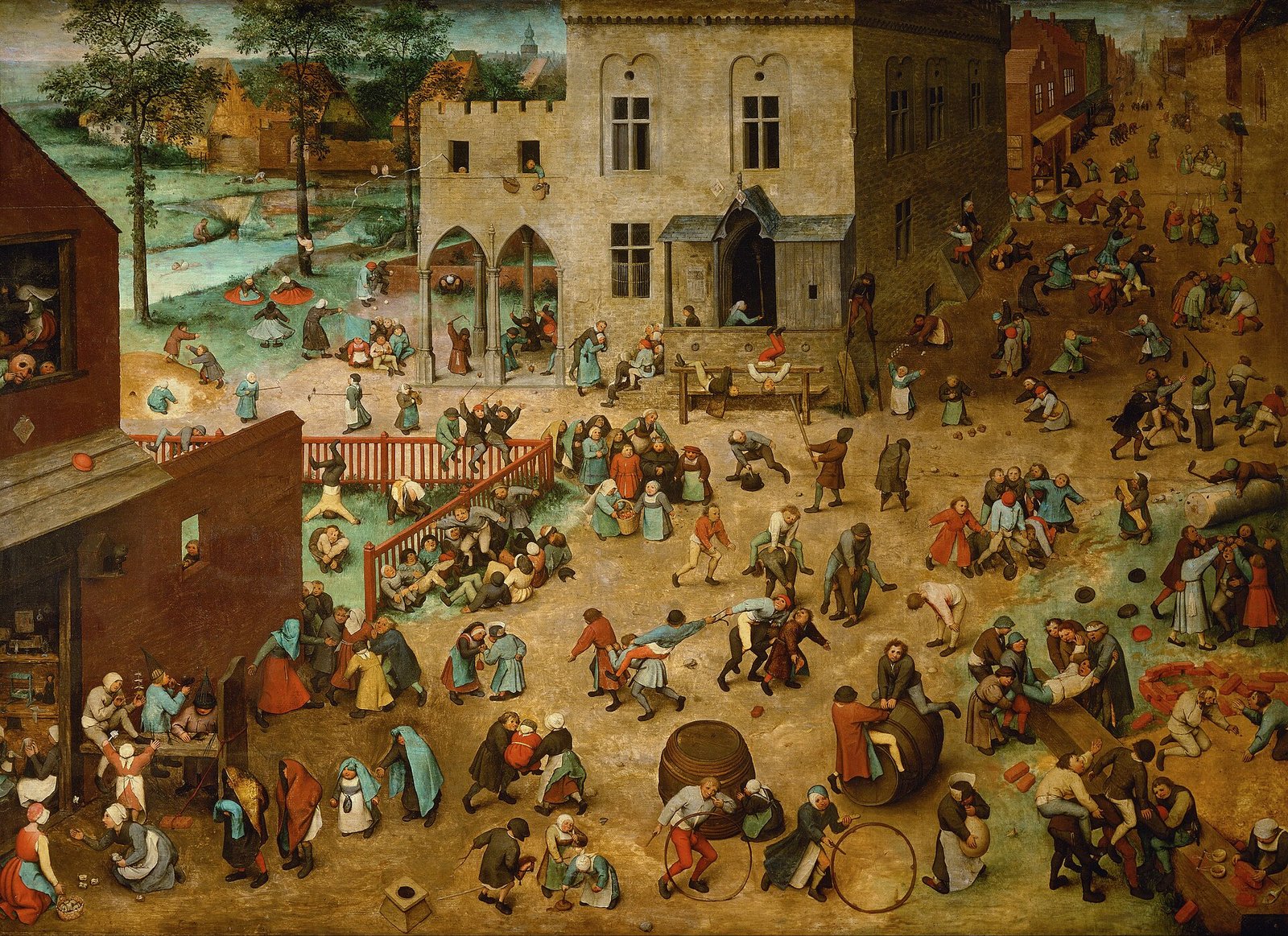
The cover image is Children’s Games by Flemish artist Pieter Bruegel the Elder. The work was created in 1560. The painting is in the style of Flemish Mannerism. More information about the work can be found here. The painting depicts 230 children engaged in 83 different games.
1 “Non-organized” is used rather then “unorganized” because the latter may be read to carry a deeper and more intense element of chaos. See, e.g., Kemp, B. J., Parrish, A., Batterham, M., & Cliff, D. P. (2022). Changes in subdomains of non-organized physical activity between childhood and adolescence in Australia: a longitudinal study. International Journal of Behavioral Nutrition and Physical Activity, 19(1), 73. https://doi.org/10.1186/s12966-022-01311-2. This paper can be found here. Kemp BJ, Parrish AM, Cliff DP. ‘Social screens’ and ‘the mainstream’: longitudinal competitors of non-organized physical activity in the transition from childhood to adolescence. Int J Behav Nutr Phys Act. 2020 Jan 14;17(1):5. doi: 10.1186/s12966-019-0908-0. PMID: 31937315; PMCID: PMC7050814. This paper can be found here. See also, e.g., Alexandru MA, Jürgen B, Arash M, Guillaume M, Lorand B. Influence of Organized vs Non Organized Physical Activity on School Adaptation Behavior. Front Psychol. 2020 Nov 19;11:550952. doi: 10.3389/fpsyg.2020.550952. Erratum in: Front Psychol. 2020 Dec 17;11:633197. doi: 10.3389/fpsyg.2020.633197. PMID: 33329181; PMCID: PMC7711162. Although not precisely on point, this paper can be found here.
2 It is recognized that organized youth sports also generally carry a cost that is not present with non-organized youth sports.
3 An organized sports entity sometimes referred to as a “house league” may well be seen as an exception to organized sports having fixed teams.
4 See, e.g., Zarrett N, Veliz P, Sabo D. Teen Sport in America: Why Participation Matters. East Meadow, NY: Women’s Sports Foundation; 2018. https://www.womenssportsfoundation.org/research/article-andreport/recent-research/teen-sport-in-america/. (last visited Nov. 27, 2026); Dworkin, J.B., Larson, R. & Hansen, D. Adolescents’ Accounts of Growth Experiences in Youth Activities. Journal of Youth and Adolescence 32, 17–26 (2003). https://doi.org/10.1023/A:1021076222321.
5 This is not to say, of course, that non-organized sports do not develop valuable personal qualities. Non-organized sports are recognized to help develop multiple social skills, inlcuding self-regulation and conflict resolution. See, e.g., Wiium N, Säfvenbom R. Participation in Organized Sports and Self-Organized Physical Activity: Associations with Developmental Factors. Int J Environ Res Public Health. 2019 Feb 18;16(4):585. doi: 10.3390/ijerph16040585. PMID: 30781609; PMCID: PMC6406465. The paper can be found here.